|
Product Details:
|
| Material: | Carbide | Surface: | TiN/TiCN/TiAlN.... |
|---|---|---|---|
| Dimension:: | Customized | Tolerance:: | +/-0.002 |
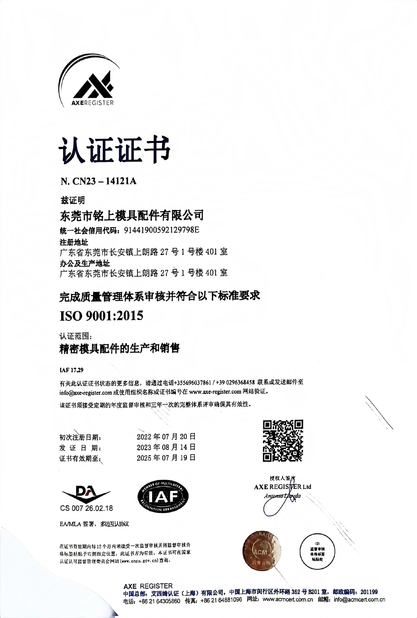
| Application:: | Punching Mold | Certificate:: | ISO:90001 |
| Highlight: | Customize TicN Coated Punch,Customized Precision Carbide Punch,Carbide Punch Carbide Mold Components |
||
Our precision carbide punches and mold components are manufactured from high-grade tungsten carbide for applications requiring extreme wear resistance and dimensional stability.
Carbide components are typically used in:
High-speed metal stamping
Progressive dies
Fine blanking tools
Micro-precision punching
Injection mold wear components
Compared to conventional tool steel, tungsten carbide offers significantly higher hardness and superior abrasion resistance in demanding production environments.
All components are produced strictly according to customer CAD drawings.
Tungsten carbide is selected when tool steel is no longer sufficient for wear performance.
Key material properties:
Extremely high hardness (up to HRA 90+)
Excellent compressive strength
Superior wear resistance
Stable cutting edge under high load
Carbide grade selection depends on:
Workpiece material (stainless steel, copper, high-strength steel)
Sheet thickness
Impact load
Production speed
Alternative materials available upon request:
ASP23
Vanadis
CPM M4
SKD11 / SKD61
M2 / D2
Carbide punches must balance hardness and toughness.
Excessively hard grades may increase brittleness risk.
Performance depends on:
Carbide grade
Grain size
Edge geometry
Surface finish
Mounting accuracy
Critical tolerances:
Dimensional tolerance: ±0.002 mm
Roundness and straightness tightly controlled
Surface finish up to Ra 0.2
High-precision cylindrical grinding ensures stable cutting edge geometry.
Carbide is harder than HSS but more brittle.
To reduce chipping risk:
Optimized edge radius control
Stress-relieved mounting design
Controlled grinding heat input
Proper grade selection
Correct engineering design extends punch life significantly.
Optional surface treatments include:
TiN
TiCN
AlTiN
DLC
Nitriding (for steel components)
Black oxide
Coatings may improve wear resistance and reduce friction, but carbide often performs well without coating in many stamping applications.
Product Type: Precision Carbide Punch / Mold Component
Material: Tungsten Carbide (custom grades available)
Hardness: HRA 88–94 (grade dependent)
Dimensional Tolerance: ±0.002 mm
Surface Finish: Ra 0.2 achievable
Manufacturing Type: Custom (Built-to-Print)
Heat Treatment: As required (for steel components)
Standard Compatibility: DIN / ISO / MISUMI / DAYTON / HASCO
Carbide mold components are commonly used in:
Stainless steel stamping
Connector and terminal production
Lead frame manufacturing
Automotive structural stamping
Medical precision metal parts
In high-volume stamping, carbide significantly reduces replacement frequency.
Processing methods include:
CNC machining
Precision cylindrical grinding
Wire EDM
EDM finishing
Surface grinding
CMM inspection
Strict inspection ensures interchangeability and repeatability.
Each component undergoes:
Raw material verification
Hardness testing
Dimensional inspection
Surface quality inspection
Inspection reports can be provided upon request.
We manufacture carbide punches and mold components strictly according to:
2D technical drawings
3D CAD files
Specified material grades
Defined tolerances and surface requirements
Both standard-compatible and special-shaped punch profiles are supported.
Q1: When should carbide be selected instead of SKH51?
Carbide is recommended for high-wear, high-speed, or stainless steel stamping where tool steel wear life is insufficient.
Q2: Is coating necessary on carbide punches?
Not always. Carbide itself is highly wear resistant. Coatings are selected based on friction conditions and workpiece material.
Q3: Can micro-diameter carbide punches be manufactured?
Yes. Micro-precision grinding allows tight tolerance control on small diameters.
Q4: How do you reduce chipping risk?
Through proper grade selection, controlled edge geometry, and stable mounting design.
Q5: Are custom profiles supported?
Yes. Special-shaped and non-standard punch designs are available.
Please provide:
2D / 3D drawings
Workpiece material type
Sheet thickness
Production speed
Surface treatment requirements
Our engineering team will review your application and recommend suitable material grades and processing solutions.
Contact Person: Miss. Merry
Tel: +8618666474704
Fax: 86-769-81153616